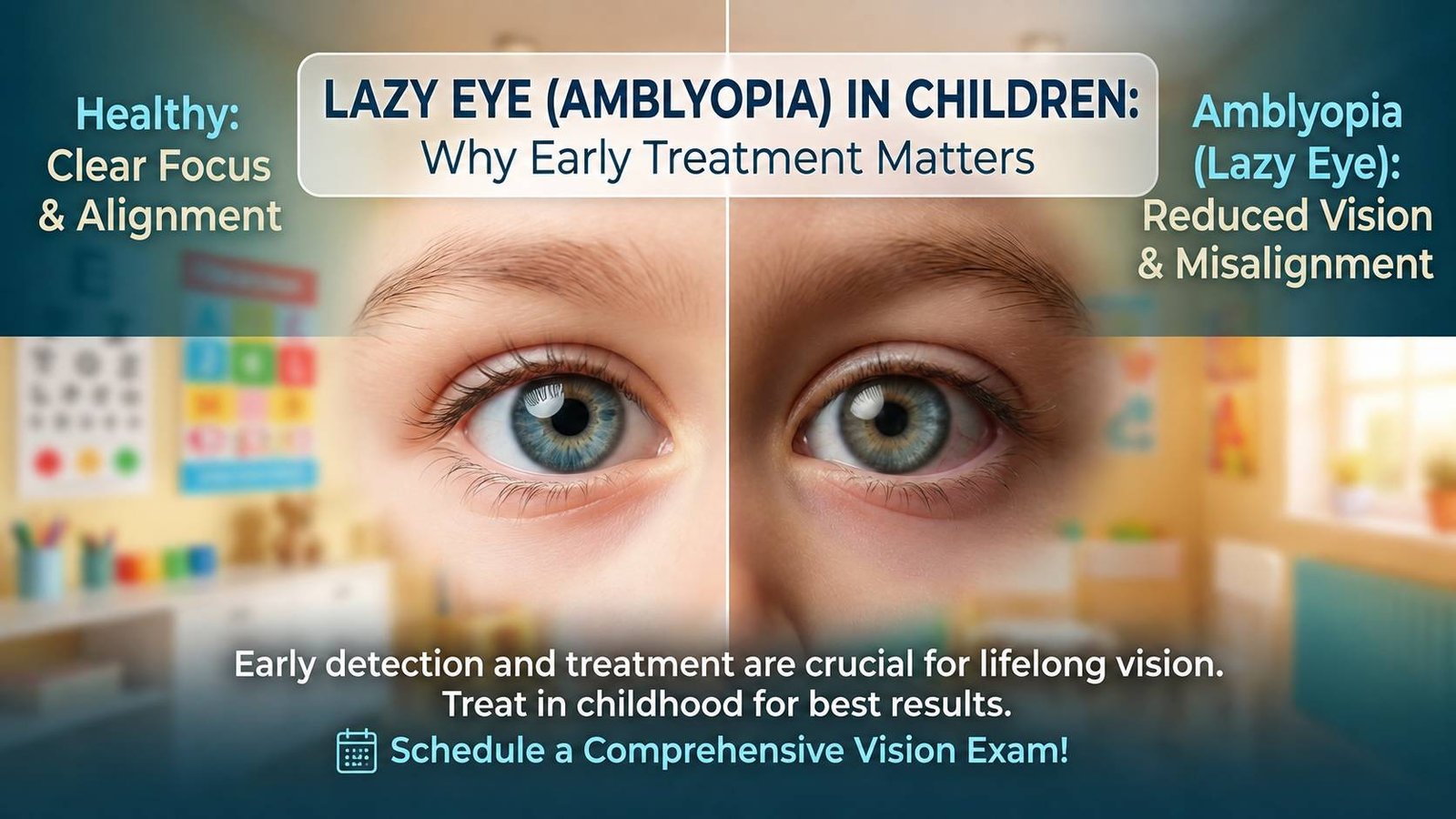
Childhood is a significant time to identify and treat eye issues because the vision of a child develops very fast in the early years of life. Amblyopia or lazy eye is a medical condition that may disrupt normal visual development when one eye fails to develop clear vision. When parents realize that the eyes of their child do not appear to work together, they may find an eye doctor near me.
The condition might be hard to identify since children might not know that they have a different vision. Visual development can be greatly enhanced by early screening and proper treatment, and awareness of this is particularly important to parents, caregivers, and teachers.
What Is Lazy Eye?
Lazy eye is a condition in which the brain starts to depend more on one eye and feeds on weaker visual information on the other. With time, the brain can override the signals of the weaker eye, thus, not allowing the eye to develop normally.
Amblyopia may occur in one eye or in rare cases, both eyes. It is not just a case of poor eyesight since the issue concerns the way the brain and eye interact in the process of visual development.
What Causes Amblyopia?
There are a number of conditions that may cause lazy eye. An apparent disparity in the prescription of the two eyes, crossed or misaligned eyes, and some conditions that prevent clear vision may all disrupt normal development.
Children with high refractive errors might not notice that they have blurred vision since they have become accustomed to it. This is why professional screening is especially useful even in case a child seems to have normal vision.
Why Early Detection Matters
The visual system of the brain is formed quickly in childhood. When one eye is continually giving blurred information in this critical stage, the brain might fail to develop the capacity to process images in that eye in the right way.
Parents looking for an eye doctor near me should consider arranging an eye examination if their child has known risk factors or unusual visual behaviours. Early diagnosis of amblyopia provides treatment with a higher chance of promoting normal visual development.
Warning Signs Parents Should Watch
When children have vision problems, they can exhibit subtle behaviours. They may often cover one eye, tilt their head, squint, sit too near to screens, or have difficulties with activities that involve good visual coordination.
A wandering eye or a misaligned eye can also be a visible indicator. Nonetheless, a significant number of children with amblyopia do not exhibit any apparent symptoms, and this is why regular childhood vision testing is still significant.
How Lazy Eye Is Diagnosed
An eye test is an examination of the clarity of each eye and the effectiveness of the two eyes in working together. An eye care professional can also administer various tests to determine the visual acuity, eye alignment, focusing ability, and overall eye health depending on the age of the child.
In case of suspected amblyopia, the cause of poor vision can also be detected during the examination. Knowledge of the cause assists in identifying the most suitable treatment strategy that suits the unique needs of the child.
Treatment Options for Children
The treatment will be based on the cause of the amblyopia and the level of development of the vision of the child. When an uncorrected refractive error is a contributing factor to poor vision, corrective glasses can be prescribed.
In other instances, an eye care specialist might advise that the stronger eye be covered with a patch over a certain time. This makes the weaker eye work more and may assist in enhancing its relationship with the brain.
Why Parents Should Follow Treatment Plans
Therapy should be regular since visual development is a process. Children might not like wearing glasses or eye patch at first especially when they are not aware of the reason why they have to wear it.
Parents can simplify the treatment process by clarifying its purpose using age-appropriate language and establishing a daily routine. Follow-up visits are beneficial to keep track of progress and make changes to the treatment when needed.
What Happens If Treatment Is Delayed?
Amblyopia may lead to permanent impaired vision in one eye. After the visual development period is over, it might be harder to improve the weaker eye.
This does not imply that older children are not able to receive treatment. Nevertheless, early intervention usually offers a better chance to enhance visual development and minimize the long-term effects of the condition.
Conclusion
Lazy eye is a vision disorder in children that should be considered since it may influence the development and processing of visual information in the brain. Parents who notice unusual visual behaviours or know their child has risk factors should consider consulting an eye doctor near me for appropriate evaluation.
Early diagnosis, proper screening, regular treatment and monitoring can play a significant role in the visual development of a child. Treatment of amblyopia in childhood provides the developing visual system with the optimal chance to develop more balanced and stronger vision.
Ready for clearer vision? Book your appointment today with our expert eye care team!